Sunday, August 19, 2012

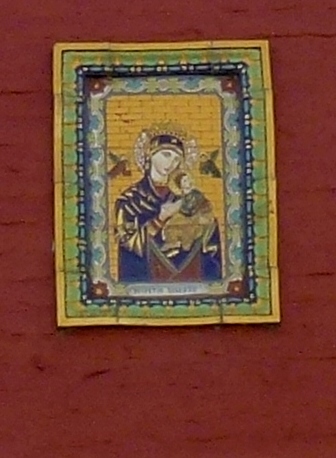
MARY - The holy virgin


57 locations, in alphabetical order
Unless otherwise noted, all photos: © Albert Hagenaars.


Although Bergen op Zoom has not always been a predominantly Roman-Catholic town, one can still see many statuettes, figurines, plaques and plaquettes representing Mary, a strong symbol of the Roman-Catholic version of Christianity, some of them having survived sieges and iconoclastic furies. This page will bring together as many of the remaining images as possible. Some have historic value, a few are also artistically interesting and most of them are the result of serial production, as especially can be seen on houses of the Twenties and Thirties of the 20th century. All were given their place however with the firm belief that Mary would protect the residents, keep them from evil, or could provide prosperity.
Bergen op Zoom is also home to one of the few processions in The Netherlands dedicated to Mary, a result of a promise, done during World War II. If the town remained unharmed, its citizens would organize a yearly parade in honor of her. Although two 'Vergeltungswaffen' came down in the centre, killing dozens of people and causing of lot of material damage, this promise was kept, up to this day.


Antwerpsestraat 36.


Antwerpsestraat 64.


Bolwerk 14.


Bolwerk 37.


Bolwerk 158.


Boutershemstraat 22.


Bredasestraat 44.


Buitenvest 20.


Burgemeester Mathonstraat 10.


Glymesstraat 22.


Glymesstraat 36.


Grote Markt 5. Photo: Rijksdienst voor de Monumentenzorg, 1965.
This statuette couldn't be saved during the restauration (in 1965)
of the house it decorated. It was replaced by a new work (see photo below).


Grote Markt 5.


Grote Markt, in St. Gertrudis Church.


Grote Markt, in St. Gertrudis Church.


Grote Markt, in St. Gertrudis Church.


Grote Markt, in St. Gertrudis Church.


Grote Markt, in St. Gertrudis Church.


Grote Markt, in St. Gertrudis Church.


Grote Markt, in St. Gertrudis Church.


Grote Markt, in St. Gertrudis Church.


Hofstraat, above the entrance of the chapel.


Hofstraat, chapel The Markiezenhof.


Hofstraat, a niche in the chapel of The Markiezenhof.


Hofstraat, in the chapel of The Markiezenhof.


Hoogstraat 7.


Huybergsestraat 14, on the corner of bar/restaurant De Hollandsche Tuyn.


Kerkstraat, garden of St. Gertrudis Church.


Kerkstraat 8.


Kladseweg 42.


Kloosterstraat 2A.


Kortemeestraat 9-11.


Kortemeestraat 26.


Kortemeestraat (corner Fortuinstraat).


Kortemeestraat (corner Fortuinstraat).


Kremerstraat 10.


Lange Parkstraat 8.


Le Grandstraat, on a wall of Mollerlyceum (college).


Maria-Hoek / Mary's Corner, where Lievevrouwestraat, Fortuinstraat, Kortemeestraat and Steenbergsestraat meet.


Lievevrouwestraat 35-37.


Lievevrouwestraat, in a niche of Lievevrouwepoort.


Meeussenstraat 2.


Noordsingel 230.


Noordzijde Zoom 78.


Noordzijde Zoom 79.


P. Turqstraat 6.


Potterstraat 58.


Prins Bernhardlaan 7.


Sint-Catharinaplein 21, on the former Vismarkt (Fish Market).


Sint-Catharinaplein 22, on the former Vismarkt (Fish Market).


Steenbergsestraat 38.


Van Dedemstraat 105.


Steenbergsestraat, Courtyard Cultural Centre Het Markiezenhof.


Wassenaarstraat 50.


Westersingel, in a niche of Lievevrouwepoort.


Westersingel 7.


Zandstraat 143.


Zuidsingel 9.


Zuidwestsingel 208.


Zuidmolenstraat 43.


Saturday, July 21, 2012

THALIAPLEIN


Remembrance plaque in honour of local soldiers killed in Indonesia during the post-colonial war, often euphemistically called police actions (Politionele Acties). Only two such expeditions took place, which, altogether, lasted four weeks.
In the period 1945 - 1949 alone, 5000 Dutch troops died, a small number compared to the fatal casualties among the Indonesians, roughly 100.000 (including civilians).


Photo: © Albert Hagenaars, 20-12-2009.
www.alberthagenaars.nl

Thursday, June 28, 2012

WITTOUCKSINGEL


The last smokestack of the Nedalco factory, an alcohol mill, once a source of pollution which by the way not all the people in Bergen op Zoom disliked, now a newly restored industrial monument. Nedalco is an abbreviation for Nederlandse Alcohol. This chimney, in its heyday one of the tallest in the country, is thought to become the landmark of Schelde Vesting, a district in progress around the old harbour, which will enlarge the surface of the downtown area.
The building crane to the right indicates the construction of residential complex Vissershaven, due to completion in 2014.


The situation in 1923. This picture was taken from an KLM-plane.


The street, untill 1889 Singelweg, is called after a family of Flemish entrepreneurs. Wittouck etymologically may mean 'Witte hoek' (White corner) in Dutch. Another theory claims the name is a corruption of wind + hoek (wind + corner/area), which seems to be more logical.
In 1863 Felix Wittouck established a sugar mill in this area, the first one in BoZ. His son Paul combined the factory with a similar one in nearby Breda and called the combination NV Sucreries de Breda et de Bergen op Zoom. He also started the Société Hollandaise de Maltose, in 1886, which became De Zuid-Nederlandsche Melasse Spiritusfabriek, three years later.
The buildings on the picture are waiting to be demolished.


The remnants of industrial activity in their splendor of decay.


All pictures: © Albert Hagenaars, 2013, 2014.


Newer Posts Older Posts Home