Sunday, June 29, 2014

KOEVOETSTRAAT


21 pictures


As good as forgotten, this lion's head guards the eastern part of Koevoetstraat.


A 'koevoet' (literally cow + foot) is a crowbar. Since also the street is bent a little, as can be seen on this picture, the name Koevoetstraat may find its origins in that tool.


At number 9, the white house, WEL was located for some years, a publising house which specializes in poetry. WEL was co-founded by Frans Mink (who lived here) in 1973. In the seventies, there was a garage downstairs.


Number 23 housed Valckesteyn in the period 1978-1980. In this gallery the first art performances in West-Brabant took place. Valckesteyn is the historic name. Valckesteyn and the adjacent houses to the right were built around 1750, after the devastating bombardments by the French army during the War of Austrian Succession (1740-1748). Over 25% of the town was flattened, more parts got heavily damaged. Until then the town was called La Pucelle (the virgin), since even the mighty Spanish armies didn't succeed to conquer it. It's only fair to say that during their most serious attempts, in 1588 and 1622, artillery was not as powerful and sophisticated as it was in the 18th century.


Not the biggest building in the street, neither the oldest, the former synagogue however is the most important complex here.


Initially, the Jewish community of Bergen op Zoom used the first floor of the local Weighhouse as a place of worship. According to the text on 'the first stone' of the present building, laid by Mr. S.L. van den Broeck, constructing began on the twelfth of the month Eloel.


The interior before World War II. Photographer: unknown.


The text "Door milddadigheid van den besten Koning 5593" means "Thanks to the benevolence of the best king 1832", refering to a gift by king William I (1772 - 1843), who ruled in the period 1813 - 1840. He was king of The United Netherlands (the actual Netherlands plus Belgium) as well as duke of Luxembourg. During his reign the Belgian Revolution (1830 - 1839) took place, which led to the independance of the Southern Netherlands, called Belgium from then on. The ties between the northern Netherlands and Flanders nevertheless remained tight.


Some lines from the poem by Benno Barnard, written especially for this place on request of Stichting Stenen Strofen (Foundation Stone Stanza's), an organization which strives for integrating poetry in the urban tissue. Some towns with similar intentions are Leiden (with over 100 texts), Middelburg and Den Bosch. In BoZ about 20 poems have appeared on buildings so far.


Barnard's complete text, refering to the fact that a local national-socialist used the complex as a depot for potatoes. David Colmer made the following English translation:


SHUL

On the wall of a former synagogue

Passer-by, this was a house of prayer
for nonzealous believers:
Salomon Samuel Frank, shopkeeper,
Nathan Jakob, of honest conduct,
name them. Here
they gathered: instructed
by forefathers, borne
by tradition.

Realise:
there is no such thing
as a former shul.

Think of the bastard who stored
his winter potatoes inside.
It is not nothingness
that terrifies
but its revelation in banality.

Even now, a cold millennium later,
an old man still stands
under the eternal lamp
mumbling in all his unshavenness
at the ark containing the names
of people death
scooped up like so many spuds:
Sam, Israel, Esther, Benjamin, Jakob.

You who are a passer-by,
as they were,
name them.


The newly formed square connecting the old and new shopping centres was called after Mozes de Hes (1864, Hoogeveen - 1942 Auschwitz), who was a religious teacher in Doetinchem, Smilde, Roermond, Gorredijk and Vlissingen. In 1926 he was appointed teacher and cantor in Bergen op Zoom. In 1942 he moved to Amsterdam. Shortly afterward, October 5th, he died in Auschwitz.
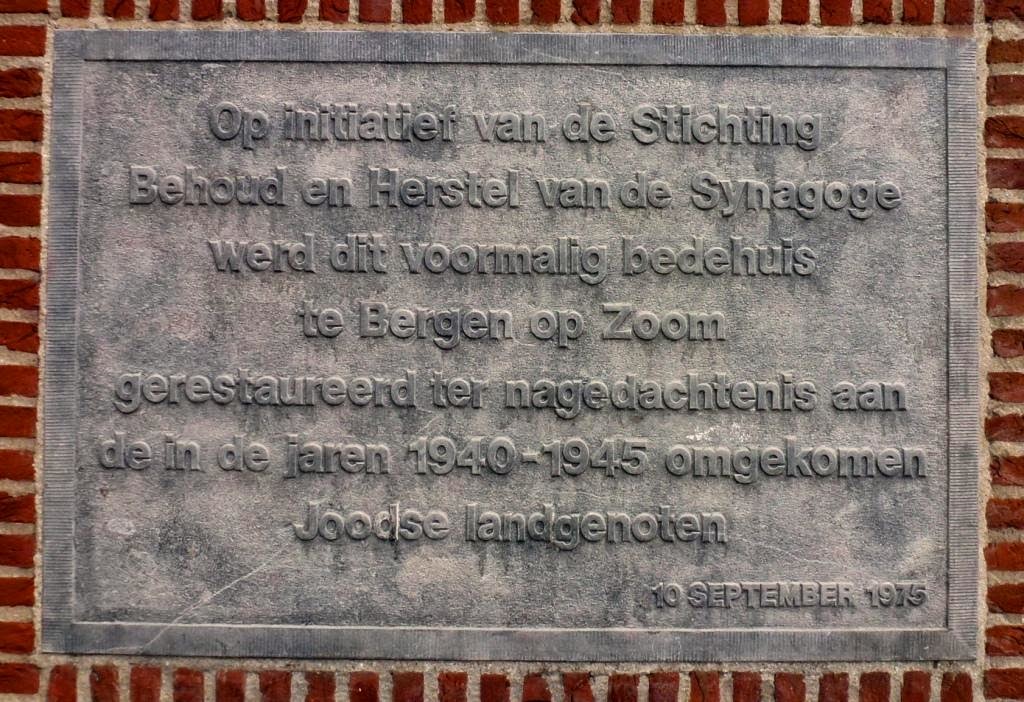


A plaque commemorating the opening of the restored synagogue by the ambassador of Israel in 1975. Between the end of the war and the early seventies, the building had fallen to ruin. Just before the remnants would be demolished in a slum clearance, the synagogue could be saved, thanks to the vigilance and perseverance of a small group of concerned residents.


The restoration works were also performed as a dedication to all the Jewish Dutch who didn't live to see the liberation. Few Jewish fellow townsmen returned to BoZ, too few to be able to reestablish the religious function of the building.


This sign explains that the synagogue was declared a national monument in 1975. Since 1996 the place is open to the public. On the first floor there is a exhibition. The new interior was, with much respect for the former functions, designed by artist Jan Wessendorp.


Many houses in the street were abandoned, due to their poor state after WW II. Since the eighties the downtown area has increasingly become a popular place to live in. Even on the Parade, a big square between Koevoetstraat and the main church, shops and apartments were built.


A new transom window in 'old style'.


All the shops, offices and apartments to the left are new, built between 2001 and 2006.


This double door is a design from the seventies.


After all the mistakes in favour of urban renewal during especially the sixties and seventies, most people in Bergen op Zoom realize it is essential to keep their town's heritage. In order to find a balance between old and new the town may not fossilize to become only a monumental area like some other historic 'fairy tale' towns. Since the centre has been classified as a protected area, new streets and constructions must however show respect to the environment, meaning for example that materials, size, colours and texture should fit. This process is continuously going on with ups and downs. The Parade-project, in which Koevoetstraat partially is situated, was designed by a group of international architects: Rob Krier / KCD, bOb Van Reeth / AWG, Sjoerd Soeters and Jan Weyts. Investors Rodamco and Vesteda made it possible to add 18.000 m2 retail space, 81 apartments and 2 parking garages with together 470 places to the town's functions and facilities. It helped Bergen op Zoom to be awarded Best Centre of The Netherlands in 2007, one year after completing the works. This corner is an example of mixing old and new elements.

Wednesday, April 30, 2014

PARALLELWEG

For quite a number of years they ruled advertisement in the public domain: murals for all kinds of products. In The Netherlands, where there must have been thousands, not 100 have survived. Thanks to negligence, in Bergen op Zoom two of them are still there. They have even been restored!
One shows 'Miss Blanche', a brand name of Virginia Cigarettes. Photo: © Albert Hagenaars.


Miss Blanche's location, although not in the centre, is perfect: all travelers by train from Vlissingen to Breda/Rotterdam could admire her, since the house in question is on Parallelweg, a road along the railway line, as the name partly indicates. Photo: © Albert Hagenaars.


The painting seems to have been made by Nithes Couwenberg after a design (ca. 1925) by Hungarian artist Vilmos Huszár (1884 - 1960). Vilmos Herz as his real name was, lived in The Netherlands and was a co-founder of De Stijl, one of the most important European trends in art in the 20th century. Photo: © Albert Hagenaars.


In September 2008 the mural was restored by Wendy Schoenaker. In order to keep the colours vivid as long as possible she used mineral paint. A tree that blocked the wall, was cut. Photo: © Albert Hagenaars.


Bergen op Zoom is not the only town which boasts a Miss Blanche by Huszár; Culemborg and Leiden are the other lucky ones. Their murals have also been restored. Here's the one in Culemborg. Photo: © Albert Hagenaars.


The image was painted on a side wall in the Achterstraat. The house itself is located Tollensstraat 36. Photo: © Albert Hagenaars.


If you like irony: in Bergen op Zoom cigaret producer Philip Morris International Inc. runs the biggest as well as one of the most modern factories of the world. It produces a number of brands, like Marlboro. Until recently it made 92 billion cigarets per year. Partly due to less consumption in Europe the company decided to close the main plant in 2014. Two departments, 'Expanded Tobacco Plants" and "Flavor Processing Centre", will be kept operational. So, Miss Blanche beats Marlboro, at least in BoZ...


Vilmos Huszár.


www.alberthagenaars.nl

Friday, January 31, 2014

ANTWERPSESTRAATWEG

11 pictures


This huge complex, called Juvenaat Holy Heart, was realized in the period 1903 - 1905. Here young men were educated to become priests.
The buildings were demolished in 1993. The front, which was meant to survive in a new structure, had to be broken down one year later, officially because of bad maintenance.


The situation in 1926. Behind the school can just be seen a brewery.


The chapel.


One of the stairwells in the western wing. The decorations
were painted by local artist Fons Gieles.


One of the many corridors.


Cloister, east wing, downstairs. Fons Gieles made the paintings. This photo was provided by Bert Bevers, who was one of the pupils of Juvenaat.


The so-called "Cour" or playground.


The later built wing where the 'fraters' were housed.


Also see this video about Juvenaat


And also see:
Frozen Poets - Statues, graves and other traces of poets

Dutch poetry in Indonesian translation


www.alberthagenaars.nl

Saturday, December 28, 2013

BEURSPLEIN

More text will follow


The small-sized Beursplein plays an important role in Bergen's cultural life. Surrounded by French, Mexican and Japanese restaurants as well as Irish and Dutch pubs and the Markiezenhof (Court of the Marquis), it houses a X-mas crib in December.


The Beursplein was only realized by the end of the 15th Century. It's first name was Sint-Jansplein (St John's Square), after a statue of this saint. When trade became more active, the name was changed according to this new function. Beurs means exchange, fair and market.


Many locals flock together on the little square in the weekends before Carnival really breaks loose and will attract many visitors from all over the country. Bergen op Zoom is, together with Maastricht and Den Bosch, one of the most popular places to be during Carnival.


Underneath Beursplein the Grebbe can be found, once a mediaeval canal of about 800 meters between the northern part of town and the old port, later a notorious sewer and at present, being one of the oldest complete underground water systems in the country, a national monument which can be visited regularly. The waste water is now managed through a large synthetic pipe, partly hidden in the ground, as can be seen on this picture.


www.alberthagenaars.nl

Saturday, November 30, 2013

BLEEKVELD


While visiting the neighbourhood around Bleekveld, one can easily think of a 'begijnhof'. A begijnhof most of the time is a walled complex consisting of a courtyard and cottages originally built in the 14th-century for a group of pious, charitable women (the Beguines). A central place was given to a chapel or church. Occasionaly there was also a graveyard. The begijnhof is a specific urban feature of the southern part of the former Netherlands (including nowadays Belgium and parts of northern France). All together there were 70 begijnhof complexes. Just a few were found in the north of The Netherlands and in Wallonia.

Professor Henri Pirenne explained the success of the Beguines by the fact that, due to violence, military operations and war, there were far more women than men. In his view single women saw no other way to survive than to unite and ask the rich for help. In exchange they would look after the sick and poor. In a begijnhof the rules were less strict than in a traditional convent.

In Flanders to this day remain 26 begijnhof complexes of which 13 are listed by Unesco. In alphabetical order these are: 1. Bruges/Brugge, 2. Dendermonde, 3. Diest, 4. Gent (Klein Begijnhof), 5. Hoogstraten, 6. Kortrijk, 7. Leuven (Groot-Begijnhof), 8. Lier, 9. Mechelen (Groot Begijnhof), 10. Sint-Amandsberg, 11. Sint-Truiden, 12. Tongeren and 13. Turnhout.

In The Netherlands only the sites in Amsterdam and Breda survived. Bergen op Zoom possessed a begijnhof from 1498 until 1580, when the buildings were demolished during religious riots. Not much later the authorities realized fortifications on the same spot. In modern Bergen op Zoom only the name remains: Begijnhofstraat. On the other side of the busy Noordsingel, part of the town’s centre ring, we find a street with little white washed houses and cobble stones as well as a green, called Bleekveld, where once sheets were laid out in the sunlight to bleach.
It is not difficult to sense here what the atmosphere in the nearby begijnhof may have been like... Even the signs help: 1. no entrance and 2. a reference to medical support.


A fragment of the map by Jacob van Deventer, ca 1545.


The begijnhof on a map published by F. Hogenberg in
1581.


The place of the begijnhof (ca no. 12) on a reconstruction
by Han Bos, 2001.


On a map in the book Historische stedenatlas van Neder-
land.


MORE INFORMATION WILL FOLLOW


www.alberthagenaars.nl

Thursday, October 31, 2013

BOULEVARD


On 29 January 1574, just off the coast of Bergen op Zoom, a sea battle took place between a Spanish fleet (two squadrons consisting of over 100 ships, led by admiral De Glimes and Romero) and rebel ships under the command of Lodewijk van Boisot and Joost de Moor. The Spanish fleet was destroyed. Twelve hundred Spaniards, including De Glimes, perished in the flames of the burning vessels or fell in the struggles that raged on their decks. As a result Middelburg, the main town of the province of Zealand, capitulated to 'de Zeegeuzen' or 'Sea Beggars', a French nickname for the rebels. The battle was an early victory for the Dutch in the so-called Eighty Years' War (1568 - 1648), which would lead to the independant state of The Netherlands.

Artist Hugo Vrijdag used references to this naval battle in his work 'Windvanen' ('Vanes'). One can also symbolically see a squadron in the stainless steel sculpture. It was established in 1999, on a spot where the new district Bergse Plaat embraces the Binnenschelde, a compartmentalized area of the Oosterscheldt estuary.


www.alberthagenaars.nl

Monday, September 30, 2013

ZUIDZIJDE ZOOM


As a child, Ludwig Lazarus Zamenhof (1859 - 1917), the designer of Esperanto, must have been fascinated, if not thrilled, by the Biblical story of the Tower of Babel.
He was born in Białystok, then part of the Russian Empire, now situated in eastern Poland. His native language was Russian, but he also spoke Yiddish and Polish, which became the native language of his children. His father was a teacher of German, and Ludwig also spoke that language fluently. He mastered French, Latin, Greek, Hebrew, and English and was interested in Italian, Spanish and Lithuanian.


Weary of all linguistic misunderstandings and confusion, young Zamenhof tried to come up with some kind of international language which would facilitate easier ways of communication. In 1887 he used the name Dr. Esperanto, meaning "someone who hopes" to publish the book 'La internacia lingvo'. His language however got the name Esperanto.


In 1905 the first congress in Esperanto took place in France. These days Esperanto is spoken in 120 countries by 2 million speakers. Every year many congresses in Zamenhofs language are organized.


In The Netherlands there are six monuments dedicated to the linguïst and his amazing project: in the southern border town Bergen op Zoom, in Den Burg (in the island of Texel), in Leeuwarden (the capital city of the province of Friesland), in Utrecht, in Oost-Vlieland ( a hamlet in the island of Vlieland) and in Zwolle (the capital city of the province of Overijssel).


In Bergen op Zoom the monument was established in 1933. Present was Lidia Zamenhof,Ludwig's daughter.


MORE INFORMATION AND PICTURES WILL FOLLOW


www.alberthagenaars.nl